Context
In shift-based businesses, an absence two hours before the shift costs the manager thirty to sixty minutes of phone calls: who is free, who lives nearby, who should not be asked again because they closed last night. Sometimes the shift is not covered at all.
Shift Rescue is an AI agent that takes that job: it talks to the employees over WhatsApp, decides who can cover the shift, offers it in waves, keeps the first acceptance and updates the rota. The manager stays in control and is only asked to intervene when the agent reaches something it must not decide alone — an overtime approval, a partial coverage, or a rescue that nobody accepted in time.
Constraints
- The manager decides anything that affects people. Overtime, partial coverage and schedule changes always go through an explicit approval; the agent proposes, it never approves.
- Privacy by design. The absence reason is never asked for and never stored; if an employee volunteers health details, the stored body is redacted before it touches the database.
- Nothing is left stuck. Every rescue either ends covered, or escalates to the manager with a summary of who was contacted and what each person answered.
How it works
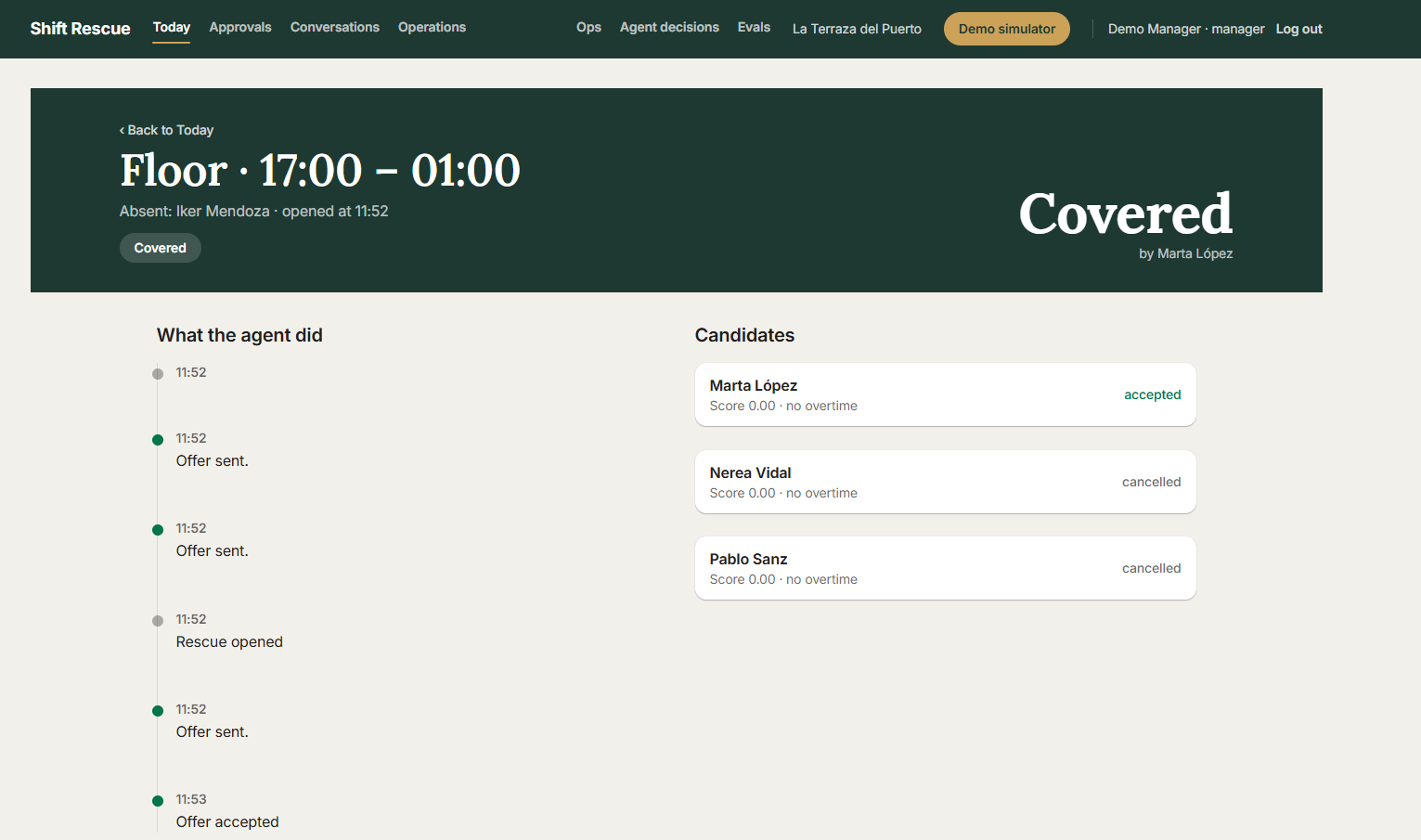
The employee writes on WhatsApp; the webhook validates the provider signature and answers in milliseconds, with the thinking delegated to a background worker. The LLM interprets the message and writes the reply, always with a validated structured output and with a deterministic parser as the fallback when the provider is slow or down. The rescue itself is a state machine over deterministic rules: roles, rest between shifts, weekly hour caps, availability, quiet hours and fairness across employees. Every transition is audited, so the dashboard can show the whole story of a case and each LLM decision carries its own cost and latency.
A simulator lets the whole flow be reproduced without a second phone — including a shared demo clock to bring a deadline forward — and the manager’s dashboard is live: a change produced anywhere reaches every open screen over a WebSocket.
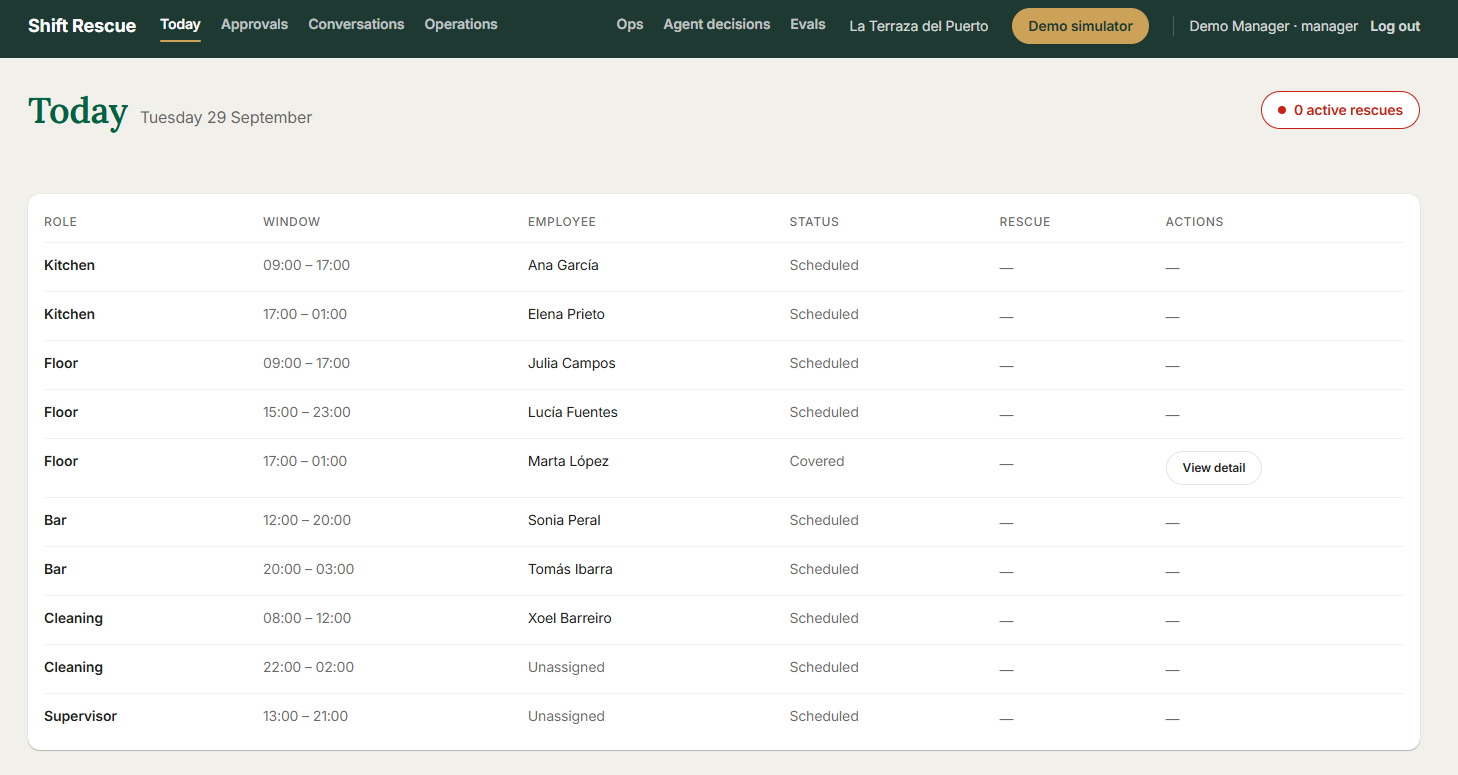
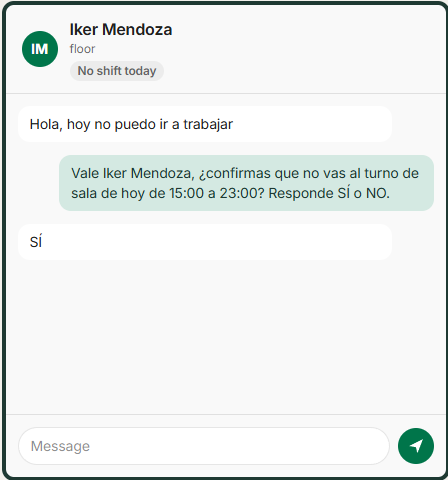
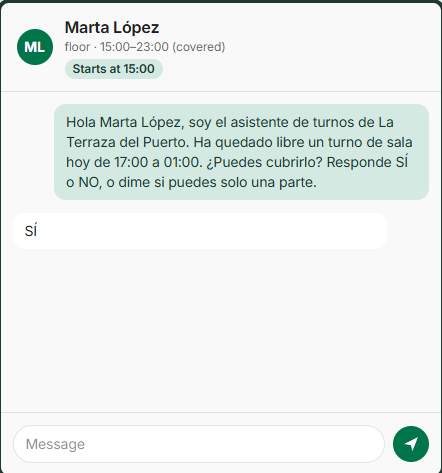
The flow, from the rota to the covered case (drag or swipe):
Stack
| Layer | |
|---|---|
| Backend | Python 3.12, FastAPI, SQLAlchemy 2.0 async, Alembic, PostgreSQL, Redis |
| Async work | Celery (worker and beat), broker-owned timers with a reconciliation sweep |
| AI | Strands Agents SDK with OpenAI, structured output validated with Pydantic, no autonomous tool loop |
| Messaging | Twilio WhatsApp (signature-validated webhooks, sandbox for the demo) |
| Frontend | React 19, TypeScript, Vite, Tailwind, TanStack Query, live WebSocket channel |
| Observability | OpenTelemetry to Langfuse Cloud (traces, cost and latency per call), structured logs, alerts, Sentry |
| Quality | 515 backend tests, 199 frontend tests, property-based tests, strict typing and linting |
| Delivery | Docker Compose, Caddy with automatic TLS, AWS (EC2, ECR, SSM, IAM with OIDC) and GitHub Actions |
What made it hard
The agent was the easy part. The hard part was trusting it, and the honest material is in the bugs:
- A quality gate that had been passing for months because it compared keys that did not exist, so it skipped every check. It now fails closed.
- Test fixtures that described a world production never sent — a context key the orchestrator did not include — which is how an employee confirming their absence received “I don’t understand you” in production with a green suite.
- Timers that never fired: the queue lived in one process and the worker runs
twelve. Fixing it uncovered an audit id of 81 characters against a
VARCHAR(64)column, which meant no rescue had ever escalated. - Tests that passed on my machine and failed in CI because they reached the ambient database, and later the ambient Redis.
Each of those is written up in the field note that goes with this project.
Results
The full flow works end to end and is verified with real phones and a real model: absence → confirmation → offers → acceptance → covered shift and updated rota, with escalation and a manager decision when nobody accepts.
- ~99% intent accuracy interpreting colloquial Spanish, measured on a 150-message golden set, with 1.0 health-detail detection.
- 15 end-to-end scenarios (concurrent acceptances, quiet hours, provider outage, HRIS failures, manipulation attempts) that must finish with zero invariant violations.
- Cost per model call tracked and visible: around $0.0002 per interpretation.
The AWS deployment is prepared and automated but not activated, to stay within budget; the environment is documented in the repository runbook so it can be started on demand. The full code is on GitHub: aam9063/Shift-Rescue.