Context
A catalog of eleven chat models — from qwen3.8-flash to glm5.3 — means one decision per request: which model answers? Always the most capable is slow (51.8s average, measured); always the fastest is weak on code and math; asking the user is friction. And picking the model is half the question: several models reason by default, burning tokens and latency on trivial prompts.
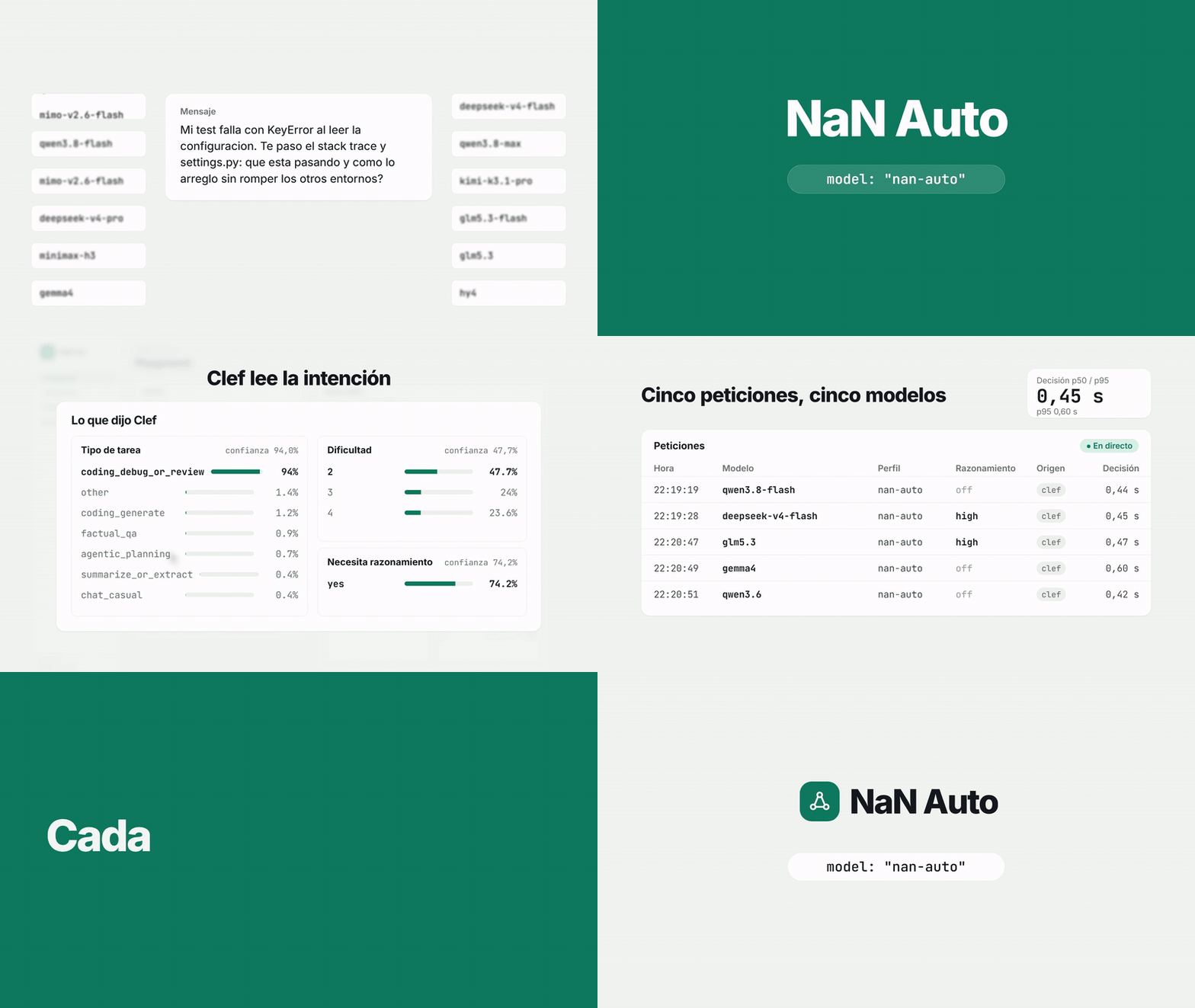
NaN Auto takes both decisions, per request. It exposes one OpenAI-compatible endpoint — model: "nan-auto" works from Cursor, OpenCode, Cline or the OpenAI SDK by changing only the base URL — and routes each request to the right model with the right amount of reasoning. Built for the #2 NaN Hackathon “Decide con Clef”.
Constraints
- Client owns the key. The relay uses the client’s own API key; the dashboard’s key lives only in session memory, never in
localStorage. - Clef is the classifier, not the decider. It answers one questionnaire call (task, difficulty, needs_reasoning, expected_output_length); deterministic code filters and scores. A hallucination can mislabel a task — it cannot send traffic to an excluded model.
- The client never sees a fallen model. Circuit breakers and a fallback chain walk candidates by score; only the model that actually failed is opened.
- No claim without a measurement. Policy constants start as
[HYPOTHESIS]and are replaced by the measured quality matrix; the evaluation reports its exact sample.
How it works
- Clef classifies the request in one call, budgeted at 0.8s; on timeout the gateway fails open to the default model.
- A capability filter discards models that can’t serve it (image, tools, premium budget, context, open circuits).
- The policy scores survivors with
score = fit·q − latency·l, using measured per-model latencies, and picks the winner; over the fallback chain the reasoning adapter translatesoff/low/highinto each model’s real parameters — measured, becausegemma4obeysenable_thinking:false,deepseek-v4-flashonly acceptsreasoning_effort, andkimi-k3.1-prorejects any explicittemperature. - Every decision is logged and streamed over SSE to a live dashboard: playground (decide without calling a model, see Clef’s answer and rejected candidates), live feed with p50/p95, registry with circuit state, and an evaluation screen fed by the offline benchmark.
Stack
| Layer | |
|---|---|
| Gateway | Python 3.14, FastAPI, Pydantic v2, uv, SQLite decision log |
| Dashboard | React 19, TypeScript, Vite, Tailwind CSS v4, live SSE feed |
| Evaluation | RouterBench-style harness: 28 prompts × 11 models, judge rubric 0–4, cached raw answers, baselines R0–R3 + Pareto |
| Quality | 305 backend tests (pytest + respx), ruff clean, pyright 0 errors |
| Methodology | ODD feature documents per unit, receipt-driven review with independent verifier, multi-agent development |
| Delivery | main/dev branches with pre-push protection, PRs from feature branches, conventional commits with tests in the same commit |
What made it hard
The router was the easy part. The honest material is in the report’s nineteen documented errors:
- The documentation lies by omission.
gemma4’s card said “off by default”; measured, it reasoned anyway (72 of 80 tokens,content: null) unless forced off with a parameter — and the parameter is different per model. The fix: measure every model twice, write the result into the YAML, and make tests load the real card. - The API key could leak by three paths — error echo, a redaction that truncated before redacting, and exceptions escaping the fail-open handler. Two verifier rounds with a canary key closed them. Lesson kept: a test that only proves correct behavior is not a security test.
- Green tests as fossils — one pinned a call count that contradicted the spec, another demanded blaming candidates the retry budget never tried. Both were rewritten stricter.
- And the classics: YAML 1.1 turning
on:/off:into booleans,Trueparsing as1.0(bool ⊂ int), a 402 removing a model from rotation until restart, and malformed upstream bodies breaking the fail-open path.
Each is written up with its detection and resolution in the field note that goes with this project.
Results
Measured against the real NaN API (307/308 matrix cells, raw answers cached for audit):
- The router keeps 90.9% of the best single model’s quality and beats “always the most capable” by 17.7% latency, at ~0.4–0.5s of decision cost.
- Reasoning-off really works for trivial prompts: from 72 burned reasoning tokens to 0 on measured models.
- The dashboard publishes the worst chart on its own screen: with this 28-prompt sample, the single default model sits on the Pareto frontier and the router below it — the evaluation screen says so instead of hiding it. Tuning the policy against the measured matrix is the next step.
There is no public deployment: the gateway runs locally against the NaN API with your own key; the full runbook and design document live in the repository: aam9063/nan-auto.