The problem nobody had time to fix
The second NaN hackathon (“Decide con Clef”) gave me a catalog of eleven chat models — from qwen3.8-flash to glm5.3 — and a question every API with a model zoo has to answer: which model handles this request?
The three ways out all have a cost. Always calling the most capable model: expensive and slow — I measured a 51.8s average latency. Always calling the fastest: poor quality on code and math. Letting the user choose: friction and manual decisions nobody wants to own.
And picking the model only answers half the question. Several models reason by default, so burning reasoning tokens on “what’s the weather in Madrid?” buys latency without buying quality. Two decisions per request, then: which model, and how much reasoning.
I built NaN Auto: a gateway that presents itself as just another model — model: "nan-auto" works from Cursor, OpenCode, Cline, or the OpenAI SDK with a base-URL change — and makes both decisions per request, behind an OpenAI-compatible endpoint.
The mechanics in one request
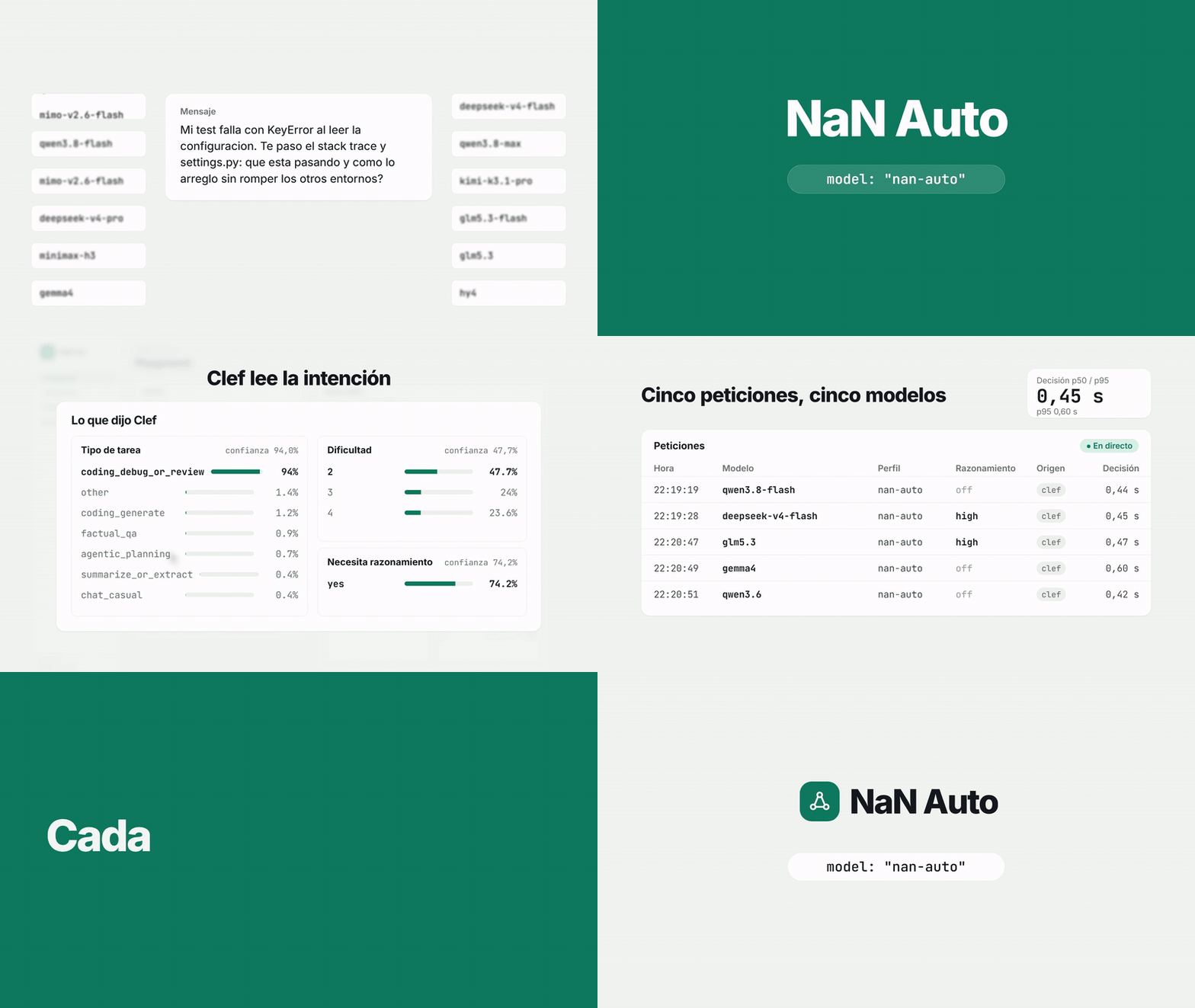
- Clef — NaN’s system-one classifier model — answers a one-call questionnaire:
task,difficulty,needs_reasoning,expected_output_length. One LLM call, budgeted at 0.8s. - A capability filter discards models that can’t serve the request: no image support, no tools, premium budget, context length, or an open circuit breaker.
- The policy scores the survivors with
score = fit·q − latency·land picks a winner. If Clef is unsure, it climbs one tier — never two. - A reasoning adapter translates the abstract level (
off/low/high) into the real parameters each model accepts. This adapter exists because of a bug I’ll get to. - The relay streams the answer with the client’s own key, with fallback: if the chosen model’s breaker is open, the router walks the candidate chain — the client never sees a fallen model’s error.
Every decision lands in a log and flows out over SSE to a live dashboard: what Clef said, the candidates with their rejection reasons, p50/p95 latency, fallbacks.
The part I got wrong, part one: the documentation lies by omission
The whole point of the router is to switch reasoning off for trivial prompts. Three days before the demo, that didn’t work at all.
The gateway returned 200 with content: null and finish_reason: "length". The root cause was two layers deep. The model card said gemma4 is “off by default” — measured: with no parameters it reasoned anyway, burned 72 of 80 tokens thinking, and left the content empty. “Off by default” actually meant you must send a parameter to turn it off. And the parameter isn’t uniform: gemma4 obeys enable_thinking: false, deepseek-v4-flash only accepts reasoning_effort, kimi-k3.1-pro rejects any explicit temperature at all.
So I measured every model twice — with and without the parameter, trivial prompt, 80 tokens — and wrote the measurement into the model card itself, cited in the YAML. Then I made the tests load the real card, so restoring the old assumptions breaks the suite.
The lesson: one measurement beats a documentation table, and a test that copies a wrong assumption verifies nothing.
The part I got wrong, part two: the key, three ways out
An independent verifier — whose job is to refute, not confirm — found that the API key could leak through three paths. The parser built error messages from the server’s own text. The redaction sliced response.text[:200] before redacting, so a key landing near column 187 kept 13 characters in the message. And a malformed body threw exceptions that escaped the fail-open handler.
Both fixes took two verifier rounds, each armed with its own canary key. And the honest conclusion is the most valuable line of the whole project: the original tests checked “the error body does not contain the key” — exactly the case a broken server does not produce. A test that only proves correct behavior is not a security test.
The part I got wrong, part three: tests as fossils
Twice, an existing green test was the obstacle. One pinned an upstream call count that contradicted the spec; another demanded that a fully exhausted fallback chain mark every candidate as failed — including ones the retry budget never even tried. In both cases the test had to lose, and the rewritten tests ended up stricter: walk ten candidates in four passes, touch each exactly once, then answer no_model without the upstream ever being called again.
A test is a memory of what I believed, not a definition of what I want. The right question about a red test is never “how do I make it pass” but “what is it asserting, and is it still true?”
Also on the list: YAML 1.1 turning on: and off: into booleans; True parsing as 1.0 because bool subclasses int (the verifier caught it — self-review wouldn’t have, I wrote that code); a single 402 removing a model from rotation until process restart; and exceptions of the wrong type breaking the fail-open path that exists precisely for errors.
The evaluation I publish with the scare quotes
I ran a RouterBench-style offline evaluation: 28 labeled prompts × 11 models = 308 cells, I measured 307 (one model thinks so much it answers empty even capped at 16,384 reasoning tokens — documented, not hidden). A judge model scored every answer against a 0–4 rubric, raw responses cached for audit.
| Policy | Quality | Latency |
|---|---|---|
| Always the default model | 3.68 | 9.84s |
| Always the most capable | 3.68 | 15.95s |
| The router (Clef + policy) | 3.57 | 13.13s |
The router keeps 90.9% of the best single model’s quality and beats “always the most capable” by 17.7% latency, with ~0.4–0.5s of decision cost. And here’s the thing: by the Pareto frontier of this 28-prompt sample, the router loses — “always the default model” dominates it. The spec said the router would sit above the line; the measurement said it doesn’t. The dashboard shows the chart with the router below the frontier instead of hiding it.
A 28-prompt sample describes itself, not the distribution — tuning the policy against the measured matrix is the natural next step. But the build ships with its worst chart on its own screen, and I’d rather have that than a green demo.
What I’d do differently
I’d write the measurement harness before the router. Nearly every bug that mattered came from trusting a written claim: a model card’s “off by default”, a config key nobody consumed, a test that fossilized the reading order of a slice. The pieces that worked — circuit breakers with injectable clocks, redaction against a canary, tests that load the real card — are the ones where I assumed my own code was guilty until proven measured.
The full report with all nineteen errors, their detection and resolution, is in the repo: aam9063/nan-auto/informe.md. Five hundred lines of tests written by an agent that timed out, rescued as an executable contract, are in there too.